A New Perspective on English Education in Maharashtra's Schools & Colleges

Education continues to evolve as schools and colleges explore new ways to make classroom learning more engaging, practical and relevant. Across Maharashtra, educational institutions are combining established teaching practices with modern resources to create a better learning experience for students. English education has an important place in this journey. It supports academic communication, access to educational resources, higher education and professional interactions.
As students progress through different stages of learning, the ability to understand and communicate in English can become valuable in many situations. However, English education today is not limited to textbooks, grammar lessons or written examinations. It also involves developing listening, speaking, reading and writing abilities, encouraging classroom participation and providing opportunities to use the language in practical situations. With changing educational needs and the growing availability of digital resources, schools and colleges have more opportunities to explore different approaches to English learning.
The Changing Approach to English Education in Maharashtra:
Maharashtra has a diverse educational landscape with schools, junior colleges, degree colleges, engineering institutions and universities catering to students from different academic and linguistic backgrounds. Institutions in cities such as Mumbai, Pune, Nagpur, Nashik and Chhatrapati Sambhajinagar along with those in smaller towns and rural areas, serve students with different educational experiences and learning requirements.
In this situation, English education needs to address more than academic syllabus requirements. Students benefit from opportunities to understand spoken language, express their thoughts, participate in discussions and communicate in different academic and everyday situations. This is also changing the way institutions approach language teaching. Alongside classroom explanations and textbook activities, institutions are exploring interactive exercises, audio-based learning, digital resources and practical communication activities. The objective is not to replace conventional teaching methods but to complement them with opportunities that make language practice more meaningful.
Bringing More Practical Learning into English Classrooms:
A meaningful language learning experience involves opportunities to apply concepts rather than only study them.
For example,
After introducing a grammar concept teacher can encourage students to use it in conversations, sentence building exercises or short presentations. Similarly, a vocabulary lesson can be followed by activities that help students understand and use new words in context.
These connections between classroom instruction and practical application make language activities more engaging.
Schools and colleges can incorporate several approaches into their regular teaching schedules:
- Group discussions and classroom conversations.
- Role playing based on everyday situations.
- Storytelling and picture description activities.
- Listening comprehension exercises.
- Reading and vocabulary development activities.
- Short presentations and public speaking exercises.
Such activities can be adapted to different age groups and academic levels. Younger students may benefit from storytelling and simple conversations, while college students can work on interviews, presentations and professional communication.
The important factor is consistency. Language skills develop through regular exposure, practice and guidance.
Understanding the Four Essential Skills of Language Education:
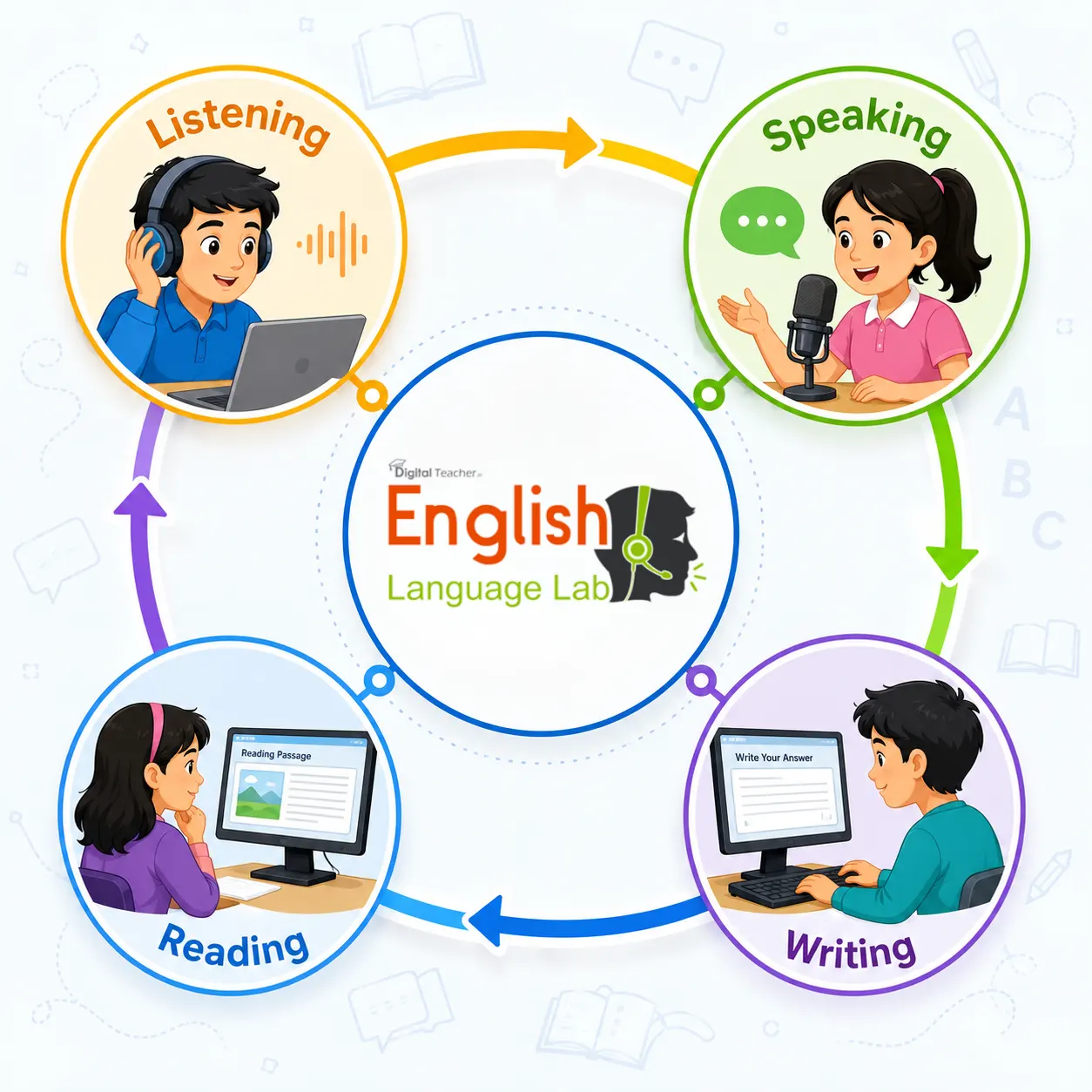
Listening, Speaking, Reading and Writing commonly known as LSRW, form the foundation of effective language development.
These four skills are closely connected and each contributes to a student's ability to understand and communicate effectively.
- Listening helps students understand spoken information, follow conversations and become familiar with different pronunciation patterns.
- Speaking allows them to express thoughts, participate in discussions and communicate ideas clearly.
- Reading develops comprehension, vocabulary and familiarity with sentence structures.
- Writing helps students organise their thoughts and present information in a clear and meaningful way.
An effective English education programme should provide opportunities to develop all four skills rather than focusing exclusively on grammar exercises or written assessments.
For instance, students can listen to a conversation, discuss its content, read a related passage and write a short response. Activities like these connect different language skills within a single learning experience.
For teachers, this integrated approach also provides more opportunities to understand how students are progressing across different areas of language development.

What Should Schools and Colleges Consider Before Setting Up a Language Lab?
Introducing an English Language Lab Software requires more than arranging computers and headphones. Institutions should evaluate whether the software, content and facilities meet their academic requirements.
A few important considerations include:
|
Phonetics and Vocabulary |
Pronunciation, speech sounds and vocabulary development should receive appropriate attention. |
|
Interactive Content |
Activities should encourage student participation and provide meaningful opportunities for practice. |
|
Teacher Monitoring |
Educators should have suitable facilities to supervise activities and manage student sessions. |
|
Recording and Playback |
These features can support repeated practice and self-review. |
|
Academic Suitability |
Content should be appropriate for the age groups and academic levels of the institution. |
|
Offline Accessibility |
Offline access allows students to continue learning without internet connectivity. |
|
Infrastructure Compatibility |
Institutions should check whether the software supports their existing computer systems and classroom equipment, including smartboards and projectors where required. |
|
Implementation and Support |
Installation options, technical assistance and ease of classroom use should also be considered. |
Evaluating these aspects can help institutions select a solution that fits their requirements and supports their language education objectives.
English Examination Results vs Real World Communication
English examinations help evaluate students understanding of grammar, vocabulary, reading comprehension and written expression. However, good examination results do not always reflect how effectively students can use English in everyday communication. Expressing ideas, participating in discussions, understanding instructions and responding confidently are also important aspects of language proficiency that written examinations may not fully assess.
This is why schools and colleges should complement classroom lessons and written assessments with practical language activities. Group discussions, presentations, listening exercises and speaking practice give students opportunities to apply what they learn. This software can further support the approach by providing structured listening, speaking, reading and writing activities helping institutions create a more balanced approach to English education.

A Glimpse of Our Institutional Network in Maharashtra:
Educational institutions across Maharashtra have different academic requirements and infrastructure needs. From schools in smaller towns to colleges in major educational centres, each institution has its own approach to classroom teaching and student development.
Our client network includes institutions from different parts of Maharashtra, representing both school and higher education segments.
Some of the institutions featured on our published client list include:
- Indira College of Engineering & Management – Pune
- PM SHRI Jawahar Navodaya Vidyalaya – Latur
- PM SHRI Jawahar Navodaya Vidyalaya – Akkalkuwa
- Dr. Vithalrao Vikhe Patil Foundation's Institute of Business Management and Rural Development – Maharashtra
- Deviprasad Goenka Management College of Media Studies – Mumbai
- Dream Land English Medium School – Ratnagiri
- Sarthak English Medium School – Shahpur, Thane
- Tarapur Vidya Mandir School & Junior College – Boisar
Our association with educational institutions across the state reflects Digital Teacher's presence in the school and higher education segments. We continue to focus on providing resources that institutions can integrate into their existing academic system.
To explore more institutions associated with us, visit our Clients page.

Digital Teacher English Language Lab for Schools and Colleges:
As educational institutions explore technology supported approaches to language education having the right software becomes an important consideration. Digital Teacher English Language Lab software is designed to support schools, colleges and other educational institutions through structured digital language learning activities.
The software covers Listening, Speaking, Reading and Writing along with phonetics, vocabulary builder, grammar and life skills & soft skills content. Its features include interactive exercises, recording and playback facilities helping institutions organise language practice sessions in a digital environment. This software can be used with Windows based computer systems and can also support classroom teaching through smartboards and projectors, depending on the institution's setup.
Learn More or Request a Demo
Discover How English Language Lab Builds Real Communication Skills
Website: www.englishlab.co.in
Email: sales@codeandpixels.net
Phone: +91 90000 90702
 |
KULKARNI He bridges the gap between graduation and employment by designing high impact soft skills modules for B.Tech, MBA, and Polytechnic students. He specializes in transforming complex professional etiquettes into actionable habits, focusing on Group Discussions, Public Speaking,and Interview mastery. His mission is to ensure every student exits the lab as an industry ready professional.    |
Frequently Asked Questions:
1. What are the four main skills involved in English language lab software?
The four essential skills are Listening, Speaking, Reading and Writing (LSRW). Together, they help students understand and communicate in different situations.
2. How can schools make English classroom activities more engaging?
Schools can introduce storytelling, group discussions, role playing, presentations, listening exercises, vocabulary activities and interactive digital resources to their classroom that helps students engaged in a particular activity and can learn more effectively.
3. Can English Language Lab software be used in both schools and colleges?
Yes, our language lab software can support both school and college environments, provided the content and activities are suitable for the respective academic levels.
4. What features should institutions consider when selecting English Language Lab software?
Institutions should consider LSRW coverage, phonetics, vocabulary activities, interactive content, teacher monitoring, recording and playback, system compatibility and implementation support.
5. How can schools and colleges request a demo of this software?
Schools, colleges and other educational institutions can contact our team directly to schedule a product demo and discuss your exact requirements. Here is our helpdesk number you can contact to - +91 90000 90702


