Disadvantages of Language Labs in India - The Honest Guide.
This is an honest blog which school principals, college administrators and education decision-makers deserve before making a decision.
If you have been searching for "disadvantages of language lab in India" or "problems with language lab implementation in schools" you are asking exactly the right question. Most language lab vendors will never write this blog. They would rather hide the real challenges behind professional brochures and promise you a seamless experience from day one.
We are not going to do that.
After working with over 7,500+ schools and institutions across India and logging more than 10,000+ software installations, we have seen every problem, every failure point and every reason a language lab either transforms a school or sits unused in a corner.
This blog lays out the honest picture of the real disadvantages, the real implementation problems and more importantly what the schools that succeed actually do differently.
The Real Problem: Most Language Lab Failures in India Are Not About the Technology
Before discussing the various disadvantages, let's first understand some background information.
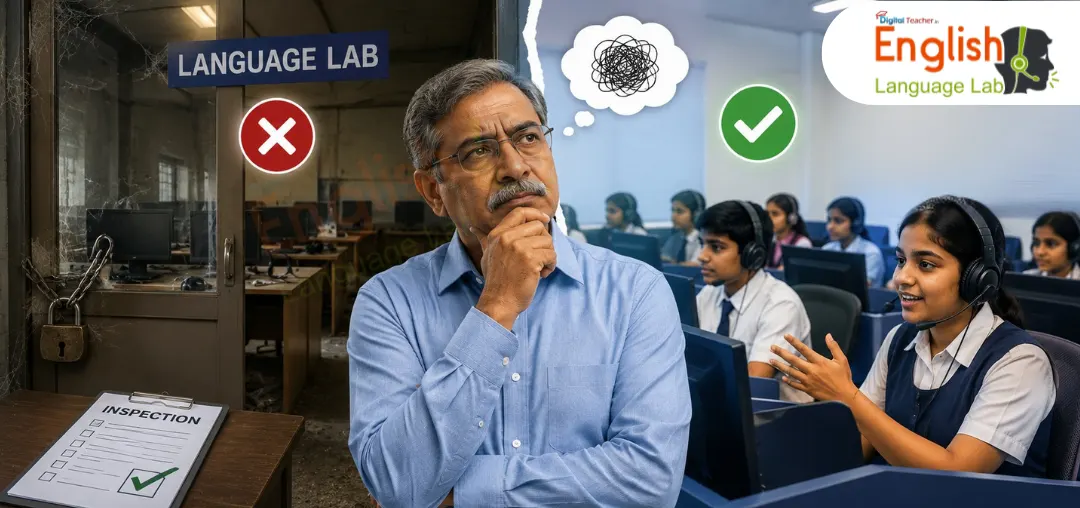
A retired professor who worked for 20 years teaching students and performing AICTE inspections throughout India. He once stated in his experience that only 10% of institutions actually run a language lab in the way it was designed to be. The other institutions either bought software from another country that is not suitable for Indian students or only opened their language lab during AICTE inspections and locked it the rest of the year.
That is not a technology problem. That is an implementation problem. And the difference matters, because the solutions are completely different.
With that context, Here are the 5 most common disadvantages and implementation problems with language labs in India:
1. Language Labs Are Opened for Inspections, Not for Students:
This is the most widespread problem in Indian educational institutions and almost nobody talks about it openly. Language labs in Indian educational institutions are often put into place to satisfy the requirements of AICTE, NAAC or state board and then effectively shut it down until the next inspection cycle. The headsets sit in a cupboard. Students never benefit from what should be a daily learning resource.
In most cases, there is no timetabled period allocated for the lab. English faculty are not integrated into the lab schedule. And because there is no visible "exam" tied to the lab, neither teachers nor students feel urgency to use it.
What solves it:
Institutions that see real outcomes treat the language lab like a mathematics lab or a chemistry lab it has a fixed period in the timetable, it is part of the internal assessment structure and usage is tracked. When a principal creates accountability around the lab, utilisation follows. The technology is not the problem. The schedule is.
2. Imported Software Does Not Work for Indian Students:
This can also be very problematic for many institutions that have already purchased international language learning software from outside sources (usually from the USA, UK or another western market).
- The first major hurdle is the accent: Consider a student from a rural area of Telangana or a small town in Bihar trying to relate to the content which is presented with are either an British accent or a General American voice.
- The vocabulary, culture and speed of delivery are all geared towards an English native speaker instead of a student who speaks English as second or third language.
The result is predictable: Students disengage within the first few sessions. Teachers lose confidence in the software and the lab gets abandoned.
How we solve:
Our language lab software is built specifically for Indian learners with Indian accented narration, Indian English contexts and content structured around the real-world scenarios like job interviews, group discussions, customer facing roles, academic presentations. The difference in engagement is immediate and measurable.
3. The Cost and Infrastructure Concern Is Real But Often Exaggerated
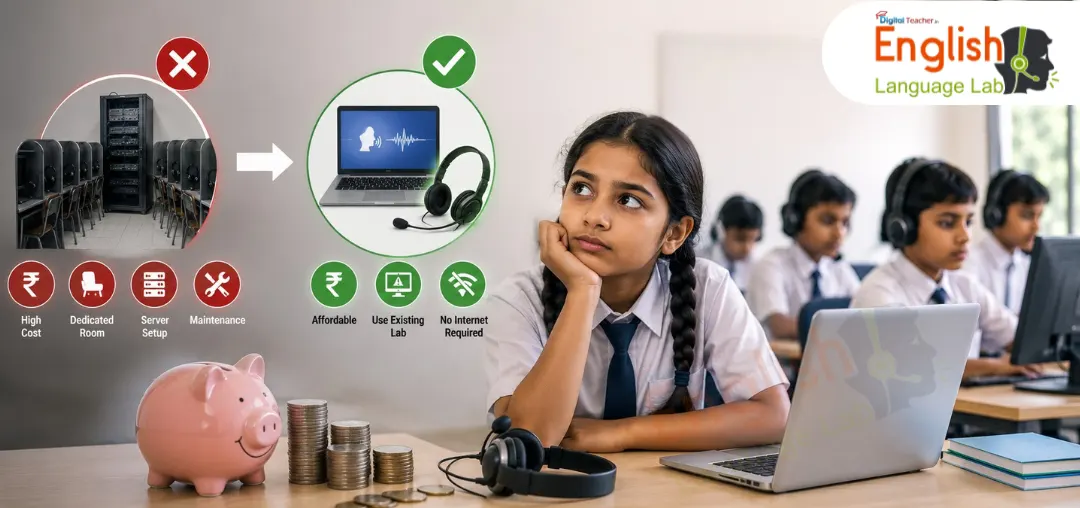
One of the most commonly seen disadvantages of language labs in India is the cost and it is not unknown that traditional language lab setups particularly hardware heavy installations with dedicated booths, customised furniture and server infrastructure can run into significant investment that make smaller schools and government institutions hesitant.
A school with an existing computer lab running basic Windows and headsets with microphones has everything it needs. No dedicated room. No special furniture. No server. No internet connection required after installation.
The institutions that avoid the lab because of "cost" are frequently comparing the price of modern software against the model of a 2005 hardware heavy lab. Those are not the same products.
4. No Lab Syllabus, No Integration with the Curriculum
One of the most crucial yet least talked about issues in India around implementing language labs is, a language lab that was set up in isolation there was no connection with the English syllabus, no mapping of outcomes to curriculum and no assessment framework will always underperform.
Students need to know what they are working towards.
Teachers need to know how lab sessions connect to what they are teaching in the classroom.
Administrators need to know how outcomes from the lab relate to institutional goals like NAAC criteria, placement readiness or CEFR level progression.
When none of these connections exist, the language lab becomes an extracurricular activity which leads to usage drops, outcomes will be invisible and the investment is written off as "not working."
How we solve:
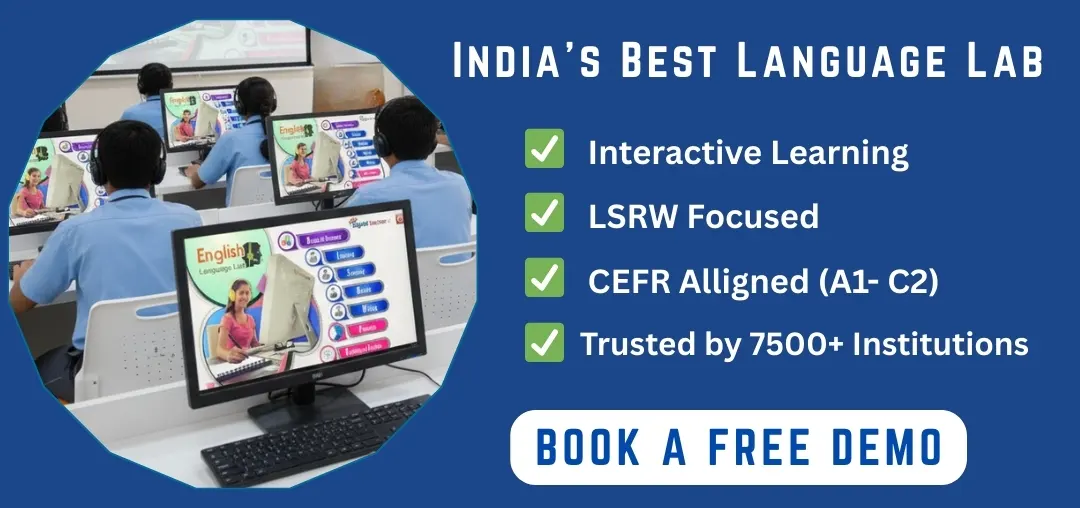
This is exactly what we have already done for you. Our software comes pre-mapped to CEFR levels (A1 to C2) structured across all four LSRW skills and organised into 435 progressive learning sessions so teachers walk in with ready to assign content and students always know exactly what skill they are building and administrators have automatic outcome tracking they can present to NAAC, AICTE or any accreditation body on any given day. The planning that most institutions struggle to do upfront is already built into the software.
5. The Digital Divide: Connectivity and Power Reliability in Rural Schools
A private school in Hyderabad and a government school in a rural district of Jharkhand face completely different infrastructure realities. For rural and semi-urban institutions, the commonly seen problems with language lab implementation are intermittent electricity, lack of reliable internet connectivity and limited IT support. These are few barriers and any vendor or blog post that dismisses them is not being honest about the ground reality.
According to UDISE+ 2024-25 data, only about 58% of schools have functional computers and internet connectivity in government schools stays around 58.6% nationally. For a language lab that requires constant internet access, this is a genuine barrier to adoption.
How we solve:
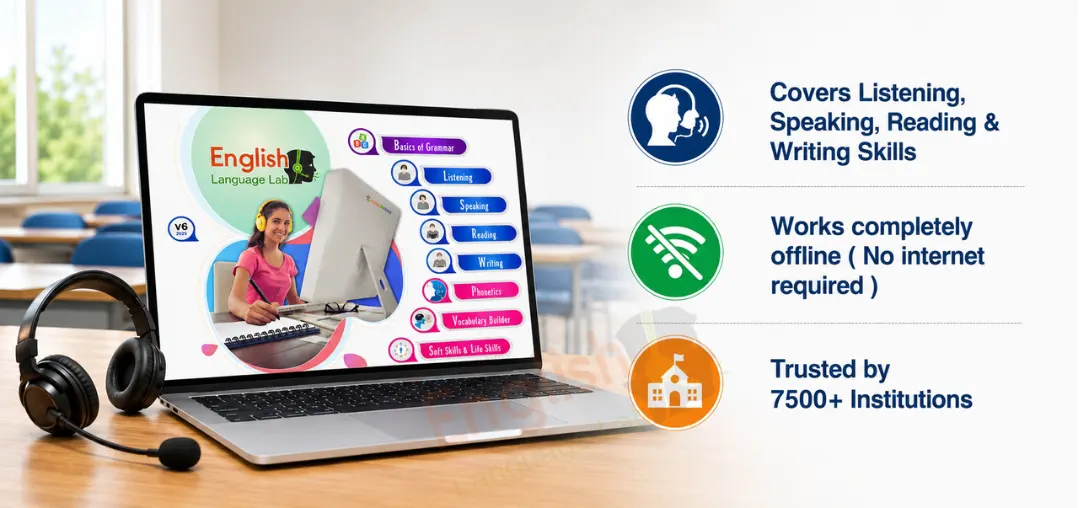
This English Language Lab is built entirely for this reality. Our software is 100% offline and the only time an internet connection is needed is during the initial installation which takes just 5 to 10 minutes. After that not a single session assessment or progress report requires internet access. Students in a government school in rural area get the exact same learning experience as students in a private school because the entire content library of all sessions, all LSRW modules, vocabulary exercises, pronunciation drills all are included in our offline software.
The Honest Summary: The Disadvantages Are Real But They Are All Solvable.
Here is what the data from 10,000+ installations across India actually shows:
The language labs that fail share common factors like they were installed without a timetable, without teacher orientation, without curriculum integration and without any outcome tracking. They were either bought to satisfy an inspector or bought without a real implementation plan.
The language labs that succeed share different common factors like they run on a fixed schedule, teachers understand their facilitation role, content is mapped to real institutional goals and usage data is reviewed regularly by the principal or HOD.
If your institution is evaluating a language lab and you have concerns about any of the problems described above like cost, teacher readiness, curriculum fit, technical specifications those are exactly the right questions to ask a vendor before you sign anything. A vendor who cannot answer them honestly is a vendor who has not actually solved them.
We have answered most one of them across 7,500+ schools and institutions in India for over a decade. If you would like to understand how Digital Teacher English Language Lab fits your specific institution, the size of your school, your goals etc. we are happy to walk you through it.
Learn More or Request a Demo
Discover How English Language Lab Builds Real Communication Skills
Website: www.englishlab.co.in
Email: sales@codeandpixels.net
Phone: +91 90000 90702
 |
KUMAR SWAMY Focuses on the science of measurable progress. He designed the lab’s advanced tracking systems, allowing educators to monitor student growth across the LSRW framework in real-time. By translating performance into actionable data, he provides institutional heads with the objective insights necessary to validate learning outcomes and academic ROI.    |
______________________________________________________________________________________________
Frequently Asked Questions
1. Is this language lab difficult to manage in a school?
Not if the software is designed for self-paced learning. Modern language lab software runs without requiring teacher supervision for every session. A teacher assigns the exercise, students work through it independently and the system tracks progress automatically.
2. Is a language lab only for engineering colleges?
No. Language labs are equally valuable and widely implemented in schools, colleges, polytechnic institutes and professional training centers. The content is structured by level from beginner to advanced making it suitable across all ages and institution types.
3. How much does an English Language Lab cost for a school or college in India?
The cost depends on two things, the number of computer systems and the type of licensing model (perpetual or annual). For a specific quote based on your institution's size and infrastructure, you can reach us at sales@codeandpixels.net
4. Does this language lab require internet to work?
Digital Teacher English Language Lab is 100% offline. Internet is only needed once during the initial 5 to 10 minute installation. After that every session, assessment and progress report runs entirely from the locally installed system.
5. What should institutions evaluate before purchasing a language lab?
Institutions should evaluate curriculum alignment, content relevance, teacher training support, offline capability, implementation strategy, assessment features, reporting tools and longterm usability.
6. What are the main disadvantages of language labs in India?
The most common disadvantages include poor implementation, lack of timetable integration, imported content that does not suit Indian learners, infrastructure concerns etc. Most issues are implementation related rather than technology related.
7. Why do many language labs fail in schools and colleges?
Many language labs fail because they are installed without proper planning, timetable allocation, teacher orientation, curriculum integration or outcome tracking. When language labs are treated as a compliance requirement rather than a learning resource, student usage and learning outcomes fail.


