Compliance Mapping – How Digital Teacher Lab Matches Government / Regulatory Requirements
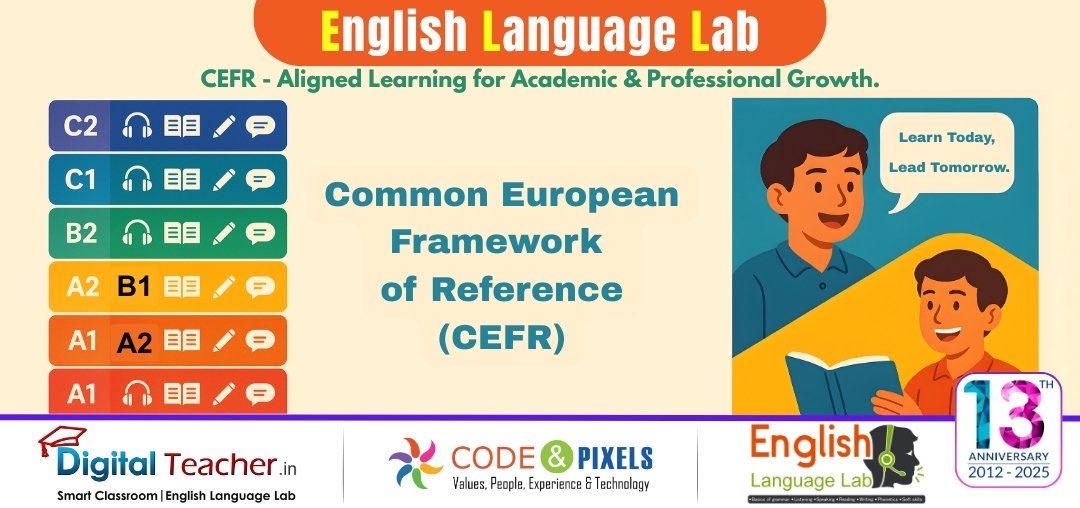
Governments didn’t mandate Language Labs just to introduce another subject they did it because English communication skills directly influence employability, higher education readiness, and global competitiveness.
Language Labs solve gaps that traditional classroom teaching cannot address.
Here are the clear reasons:
1. To Improve English Proficiency and Reduce Learning Gaps
In many parts of India, especially rural and semi-urban areas:
- Students can read and write, but struggle to listen and speak fluently.
- Mother Tongue Influence (MTI) affects pronunciation.
- English is often used only for exams not communication.
A language lab provides structured training in:
- Listening
- Speaking
- Pronunciation
- Fluency
- Accent and Stress Patterns
This aligns with NEP 2020, which focuses on multilingual competence and functional language skills, not just grammar memorization.

2. To Align Education with Employability and Industry Requirements
Recruiters repeatedly report that graduates lack:
- Spoken English confidence
- Presentation skills
- Group discussion skills
- Interview readiness
A traditional chalk-and-talk classroom cannot simulate:
- Voice recording and self-assessment
- Conversation drills
- Role-based speaking scenarios
- Mock interviews
Government policies now link education to job readiness, and language labs directly support this.
3. To Promote Outcome Based Education (OBE)
Bodies like:
- AICTE
- NAAC
- UGC
- CBSE Skill Programs require measurable learning outcomes.
A language lab provides:
- Digital progress tracking
- Assessments
- CEFR-based competency levels (A1–C2)
This makes evaluation objective not based only on subjective teacher judgment.
4. To Standardize Communication Skills Training Across Institutions
Before language labs, training varied widely depending on the teacher's capability.
With a digital lab:
- Content is structured
- Methodology is standardized
- Students across different regions receive equal exposure
This brings uniformity in language skill development across the country.
5. To Comply with Communication Skills Curriculum Requirements
Government and accreditation bodies made language labs mandatory in many states because the syllabus specifically includes:
- Phonetics
- Accent training
- Soft skills
- Listening comprehension
- Presentation and interview skills
These topics cannot be effectively taught without audio visual tools and practice environments.

6. To Support NEP 2020 Vision: Skill Based and Technology Integrated Learning
Language labs align with NEP goals:
|
NEP Goal |
How Language Lab Supports |
|
Technology enabled learning |
Software, audio tools, multimedia modules |
|
Competency-based education |
CEFR mapping and practical output |
|
Skill development |
Communication, confidence, employability |
|
Personalized learning |
Self paced practice and individual feedback |
7. To Help First-Generation and Rural Learners Overcome Fear of English
Many students hesitate to speak in front of peers.
In language labs, students can:
- Practice privately with headphones
- Record and listen to themselves
- Improve without embarrassment
It encourages confidence especially for rural students.
AICTE / Technical Institution Expectations
AICTE and university level ELCS lab manuals emphasise:
- Communication Skills / ELCS Lab must include CALL (Computer Assisted Language Learning) lab plus Interactive Communication Skills (ICS) lab.
- Focus on:
- Listening skills
- Phonetics, MTI neutralisation
- Public speaking, presentations
- Group discussions, interviews, role plays
- Minimum infrastructure example: ~40 systems, LAN, English language learning software, master console, and high fidelity headphones.
How Digital Teacher English Language Lab Aligns
|
AICTE / University Lab Requirement |
How Digital Teacher Lab Complies (with example) |
|
CALL Lab – Listening & Pronunciation practice |
DT Lab provides extensive listening activities, phonetics and pronunciation modules; students listen, repeat, record, and compare. |
|
MTI Neutralisation |
Dedicated practice on common Indian pronunciation issues, stress and intonation; aligns with university ELCS topics on MTI and errors in pronunciation. |
|
ICS Lab – Conversation, role-play |
DT Lab includes everyday scenarios, role plays, and situational dialogues; |
|
Public speaking, presentations, GD, interviews |
ELCS syllabi list GD, public speaking, presentations, interview skills; DT Lab supports them with soft skills modules and speaking practice, which can then be conducted as live GDs/mock interviews. |
|
Infrastructure: computers, headphones |
DT Lab is designed as a software solution that runs on existing computer labs with headsets; this matches common ELCS infrastructure benchmarks. |
NAAC / UGC – Soft Skills & Communication
NAAC manuals for affiliated colleges and universities require evidence of:
- Soft skills
- Language and communication skills
- Life skills and ICT skills implemented through workshops, labs and certificate/add-on programmes.
How Digital Teacher Lab Helps in NAAC Documentation
Criterion 1 & 2: Curricular Aspects / Teaching Learning
- ELCS / Communication Skills Lab using DT software can be shown as:
-
- CBCS/Outcome based component for communication skills.
- Innovative teaching learning method (blended ILT + CBT).
Criterion 3: Research, Innovations & Extension
-
- Action research / small projects on “Impact of Digital Language Lab on students’ communication skills”
Criterion 4: Student Support & Progression
- Evidence of training for:
-
- Group Discussion, interviews, resume writing.
- Enhanced placement percentages.
- This directly links with employability and higher education readiness.
Criterion 5: Best Practices
- “Use of Digital Teacher English Language Lab for rural / first generation learners” can be documented as a Best Practice, with:
-
- Goal: Improve communicative competence.
- Practice: Regular lab sessions, blended learning, CEFR based content.
- Outcome: Increased participation, improved pass % in English, better placements.

School Education – CBSE / State Board Alignment
Digital Teacher English Language Lab explicitly mentions that:
- Content is designed as per CEFR and Cambridge English Teaching Framework but customised for Indian learners.
- It caters to the needs of State Boards and CBSE, focusing on LSRW skills, grammar, vocabulary, and functional English.
This supports:
- NEP 2020 focus on Foundational Literacy & Numeracy and communication skills.
- CBSE’s emphasis on Activity based learning, speaking & listening skills, not just rote grammar.
In Summary:
The government mandated or encouraged language labs because they:
- Improve real communication not just textbook English
- Build employability skills and confidence
- Make learning measurable and standardized
- Support NEP 2020 digital and skill based education goals
- Bridge the rural urban skill divide
- Prepare students for interviews, higher studies, and global exposure
“Language Labs were mandated because English fluency is no longer just an academic skill it's a career skill, a life skill, and a global passport.”
Learn More or Request a Demo
Discover How English Language Lab Builds Real Communication Skills
Website: www.englishlab.co.in
Email: sales@codeandpixels.net
Phone: +91 90000 90702
 |
KUMAR SWAMY Focuses on the science of measurable progress. He designed the lab’s advanced tracking systems, allowing educators to monitor student growth across the LSRW framework in real-time. By translating performance into actionable data, he provides institutional heads with the objective insights necessary to validate learning outcomes and academic ROI.    |
______________________________________________________________________________________________
Frequently Asked Questions
1. How does a Digital Teacher English Language Lab support NEP 2020?
The Digital Teacher Language Lab aligns with NEP 2020’s goals by offering technology-enabled, competency-based and skill-oriented learning. It provides multimedia content, CEFR-level progression and self-paced practice, helping students build real communication abilities rather than just theoretical knowledge.
2. How does English Language Lab improve student outcomes and employability skills?
The English Language Lab includes role-based conversations, GD/PI practice, public speaking modules, pronunciation correction and self-recording features. Students not only learn English but practice it, helping them build confidence for placements, interviews and higher-education readiness.


