Beyond Grammar: How Language Labs Build Essential Soft Skills

Traditionally, English Language was primarily focused on grammar and structure of sentences, as well as how an individual can pass a test. However, while these components still have some importance they dont define successful communication in today's world. Communication in the classroom, workplace and in social environment are evaluated on the basis of how confident a speaker is, the clarity of the individual’s message and the effectiveness of the individual's communication skills in a real world.
Consequently, the criteria for evaluating proficiency in English have shifted from correctness to confidence, clarity and connection. This is precisely the function of Modern English Language Labs, to facilitate transition from 'grammar only' to 'effective communication'.
Why Grammar-Only English Learning Is No Longer Enough
When it comes to speaking, students do hesitate because of the fear of making mistakes, being judged on that mistake, or sounding wrong. As a result, they do not use the English language to communicate but only study it as a subject. In many reallife scenarios like in interviews, presentations, discussions, meetings communication is significantly more important than having perfect grammar.
Therefore, learners must learn to think and respond in English naturally and express themselves freely without any hesitation. When a classroom is solely focused on grammar, it typically does not create an atmosphere for learners to develop these skills but a language lab is specifically designed to help students develop these skills.

The Role of English Language Lab Software in Soft Skills Development
The English language Lab software presents a way for learners to learn the language in an actionable way. Rather than just listening to audio recordings passively or forcing themselves to remember information through repetition, students will take an active role in learning English through various activities like speaking, listening and interacting in English.
In this Language Lab environment, a student begins with:
- The ability to speak with sound confidence rather than with fear
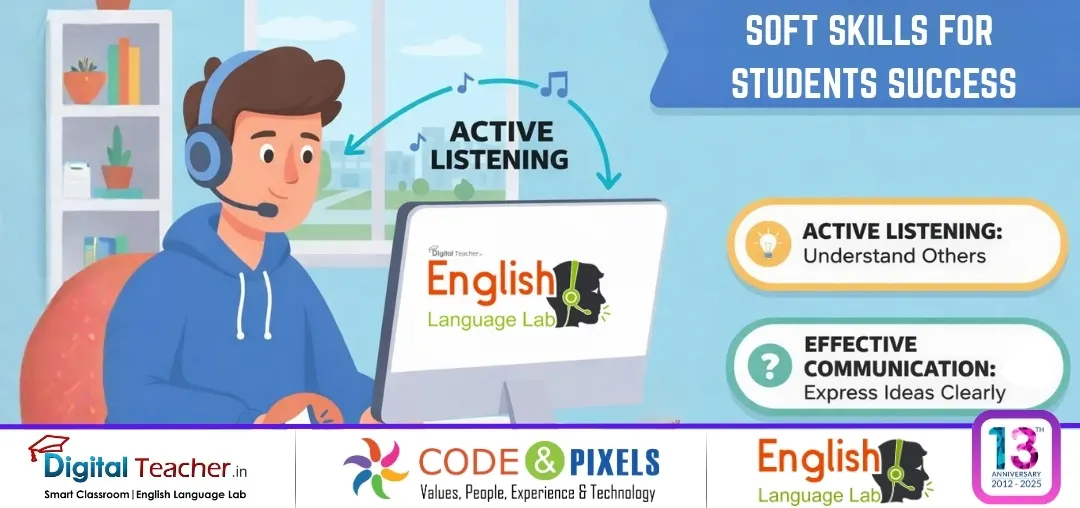
- The ability to actively listen and comprehend what is being said
- The ability to pronounce words correctly and clearly
- The ability to construct sentences by linking their thoughts together
- The ability to use vocabulary in the proper context
- The ability to give presentations and engage in discussion
Soft skills are not like a language's grammar structure which you can memorise. Soft skills develop through practice, repetition and constructive feedback which is the reason why language labs produce such positive results.
A key benefit of using Language Lab Software is that it provides students a safe environment to practice and build their confidence without the anxiety of being judged by their peers. Students use Headsets and Microphones so they can practice and improve their speaking skills solely focused on their own improvement. This sense of psychological safety will help reluctant students find the courage to participate and learn.
This Language Lab Software also offers different activities which allows the students to become familiar with everyday language. This involves activities to communicate and talk to others will provide students with confidence as they learn to speak in English. In addition, when students know how to communicate positively between themselves and others, they will have the confidence to do so in all situations.

The Teacher’s Role in a Software Enabled Language Lab
Our Language Lab Software improves rather than replacing teaching, it enables educators to be more effective at what they do in their role as an educator by allowing them to devote their time and attention to guiding, providing feedback and improving each student's performance.
As teachers monitor students’ they will be able to identify the areas where students are struggling or need additional help. The classroom dynamic shifts from teacher centered instruction to learner centered communication development makes English classes more engaging and productive.
Overcoming the Fear of Speaking English
Fear can be one of the most significant obstacles while learning English. The anxiety caused by the possibility of being judged for an incorrect grammatical error or poor pronunciation contributes to a lack of participation and ultimately leads to silence. The fear of peer judgement prevents many students from actively participating in Competitions in Schools and Colleges.
Mistakes made during training are viewed as an opportunity to learn rather than as failures thus, as students engage in regular practice with their English conversation, they will naturally develop more confidence and decrease their hesitations both inside and outside the classroom.
Soft Skills in an AI-Driven World
With the use of AI, creating and correcting grammar has become automated however, AI cannot replicate human abilities like persuasion, emotion, and interpersonal skills. Soft skills are also becoming much more important due to the rise of technology as a medium for communication. The software programs offered by an English Language Lab will help students develop the same human capabilities that cannot be automated by machines, and will give them the opportunity to improve upon their skills as they progress through school, at work, and in life.
Language Labs vs Traditional English Teaching
|
Traditional English Class |
Modern English Language Lab |
|
Grammar focused |
Communication focused |
|
Teacher centric |
Learner centric |
|
Limited speaking time |
Individual speaking practice |
|
Fear of mistakes |
Safe practice environment |
|
Exam oriented |
Skill oriented |
Measurable Outcomes Institutions Are Seeing
The institutions using our English Language Lab Software are finding that students are becoming increasingly engaged, confident when speaking, and demonstrating better pronunciation and fluency while learning English.
Teachers also report an increase in student engagement with classroom activities and communication through greater quality of classroom interaction. These results are measurable, indicative of enhanced communication skills, rather than only improvement in exam scores.
When students graduate from college or training the ability to communicate effectively enhances their chances of being hired.
English Language Lab Software allows learners to practice Interviews, group conversation, presentations and all forms of communication in a professional setting at an early stage to help students successfully make the transition from education to the workforce. Having the ability to communicate well will help students today and in the future.
Key Takeaways:
- Grammar alone is not sufficient for real communication.
- Soft skills such as confidence and fluency develop through practice.
- English Language Lab Software provides structured, pressure-free speaking opportunities.
- Software-enabled language labs support teachers and empower students.
- Communication skills are essential in an AI-driven and employability-focused world.
Conclusion: Grammar Builds Accuracy, Software Builds Communication
Grammar provides the foundation of English learning. Our English Language Lab Software builds the soft skills that turn knowledge into confident communication.
Language labs support learners by combining structure, practice and technology to advance beyond grammar and help students develop the essential communication skills required for success in academia, the workplace, and the real world.
Learn more about what are the Top 6 Soft Skills Every Student Must Learn → https://englishlab.co.in/blog/top-6-soft-skills-every-student-must-learn-in-2025
Learn More or Request a Demo
Discover How English Language Lab Builds Real Communication Skills
Website: www.englishlab.co.in
Email: sales@codeandpixels.net
Phone: +91 90000 90702
 |
HARSHITHA AGARWAL Specializes in making complex linguistic concepts accessible and intuitive. By researching real-life language applications, she simplifies grammar and vocabulary into engaging, immersive modules. Her work ensures that the English Lab’s content remains fresh, inclusive, and strictly aligned with international proficiency benchmarks, facilitating a natural transition to English mastery.    |
____________________________________________________________________________________________________________
Frequently Asked Questions
1. How does English Language Lab Software help build soft skills?
English Language Lab Software builds soft skills by providing regular speaking practice, listening exercises, pronunciation training, and contextual communication activities. These features help learners develop confidence, fluency, clarity, and effective communication skills through repeated, guided practice.
2. Why is grammar alone not enough for learning English?
Grammar alone is not enough because real communication requires confidence, clarity, and the ability to express ideas naturally. While grammar ensures correctness, soft skills such as speaking confidence and listening ability are essential for real-life conversations, interviews, and presentations.
3. How is English Language Lab Software different from traditional English teaching?
Traditional English teaching often focuses on grammar and written exercises, while English Language Lab Software focuses on communication, listening, and speaking practice. The software provides individual practice opportunities that are difficult to achieve in regular classrooms.
4. Is English Language Lab Software relevant in an AI-driven world?
Yes, English Language Lab Software is highly relevant in an AI-driven world because it helps learners develop human communication skills such as confidence, expression, and interpersonal interaction skills that cannot be replaced by AI tools.
5. Is English Language Lab Software suitable for beginners with weak English skills?
Yes, English Language Lab Software is suitable for beginners because it allows learners to practice at their own pace. The software provides guided listening and speaking activities that help beginners build confidence gradually without the pressure of speaking in front of others.


